Small Coffee Bar Ideas for Apartments and Tiny Kitchens
Updated Sep 22, 2026 · 6 min read
Short answer
A working small coffee bar fits in about 12 x 18 in (30 x 46 cm) of counter: the machine at the back, a tray in front, mugs and supplies on the wall above. With no free counter at all, use a rolling cart with locking wheels or a 24 in floating shelf plus a brewer that stores in a drawer.
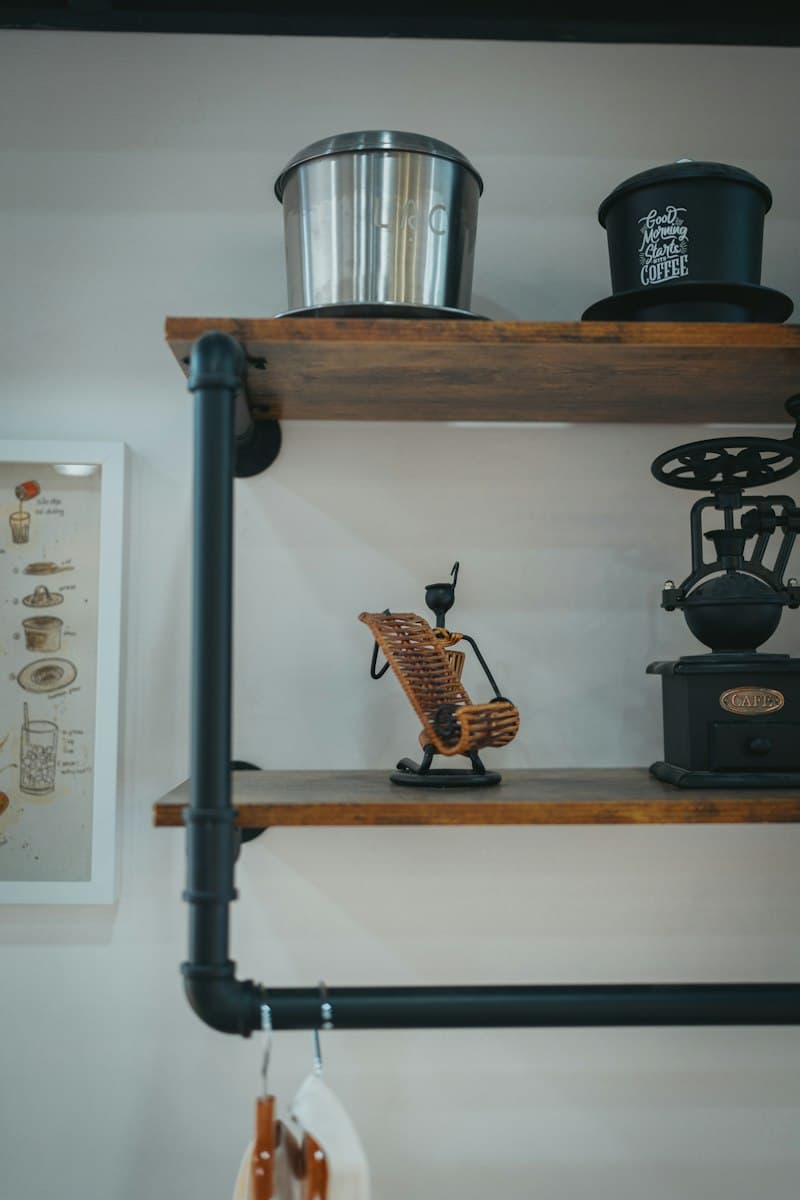
A small coffee bar needs three things: a level surface about 12 in wide, an outlet within cord reach, and somewhere above or below for mugs and beans. Everything on this page is a different way to find those three things in a kitchen that is already full.
Start by measuring your brewer, then pick the approach that fits. For bigger rooms and more styles, the coffee bar ideas gallery has the full range.
How much space a small coffee station really needs
Less than you'd think, as long as you match the brewer to the spot. Measure the machine with the lid or tank open, because that is the height you need every morning.
| Brewer | Typical footprint (W x D) | Height | Notes |
|---|---|---|---|
| AeroPress or pour-over dripper | about 4 x 4 in (10 x 10 cm) | 5-6 in | Stores in a drawer. Needs a kettle. |
| Electric kettle | 6-9 in across | 8-10 in | Doubles for tea. |
| Compact pod machine | 4-6 x 11-16 in | 8-12 in | Narrow but deep. Check depth on shallow shelves. |
| Drip coffee maker | 7-10 x 8-12 in | 12-15 in | Most fill from the top. |
| Compact espresso machine | 8-10 x 12-14 in | 12-16 in | 10-20 lb. Needs a solid surface. |
| Grinder | 5-7 x 7-9 in | 10-15 in | Add this width to the machine's. |
Standard upper cabinets sit 18 in (46 cm) above the counter. A 14 in drip machine fits under them on paper, but you'll be sliding it forward to fill it every day. If that sounds annoying, pick a front-fill or side-tank machine, or use a spot with open space above.
Compare the options
| Approach | Space it takes | Rough cost | Holds a machine | Renter friendly |
|---|---|---|---|---|
| Tray on the counter | 12 x 18 in of counter | $15-$40 | Yes | Yes |
| Rolling cart | about 16 x 24 in of floor | $35-$150 | Yes, if the top shelf is rated for it | Yes |
| Floating shelf | 24 in of wall | $15-$40 per shelf | No, supplies and mugs only | Needs drilling |
| Slim cart beside the fridge | 5-10 in gap | $25-$50 | No | Yes |
| Fold-down wall table | zero when folded | $40-$120 | Light brewers only | Needs drilling |
| Pull-out shelf in a base cabinet | zero counter | $40-$100 | Pod and small drip machines | No |
The tray method: start here
If you're not sure where to begin, put a 12 x 18 in (30 x 46 cm) tray on the counter. Machine behind it or on it, daily items on it. What is on the tray is the coffee station. What is off the tray is regular counter.
It works because the tray draws a border. A machine, a canister, and a mug scattered on a counter read as clutter. The same three things on a tray read as a setup. When you need the counter for cooking, the whole station slides sideways in one move.
One refinement: trays don't absorb anything, so drips pool. Put a silicone mat under the machine and keep the tray next to it for the dry things. Both are covered in the coffee bar accessories guide.
A rolling cart when there is no counter left
A cart creates counter space out of floor space. You need a footprint of about 16 x 24 in and an outlet nearby.
Check the weight rating before you buy. Light three-tier utility carts are often rated around 10-15 lb per shelf, which is fine for a pod machine and wrong for espresso. A compact espresso machine weighs 10-20 lb before water, and you push against it every time you lock in the portafilter. For espresso, get a cart with a solid top and a rating of 30 lb or more.
Lock the wheels before brewing. A cart that creeps during a shot ends with coffee on the floor.
Layout that works: machine on top, mugs and beans on the middle shelf, water jug and backup supplies on the bottom. The coffee bar carts guide goes through sizes and what to look for.
Keep the cart within cord reach of an outlet. A cord stretched across a walkway is a trip hazard with a hot machine on the other end. If the outlet is a few feet off, run the cord along the baseboard under a cord cover.
Wall shelves: when you can't go wider, go up
One 24 in (61 cm) floating shelf above the machine holds a canister, a grinder that you lift down to use, and four to six mugs. Screw cup hooks into the underside, spaced about 4 in apart so standard mugs (roughly 3.25 in wide) don't knock together, and you've freed a whole cabinet.
Mount the shelf 18-24 in above the counter. 18 in matches standard upper cabinets. Go higher if your machine fills from the top, and check with the lid open before you drill.
Screw into studs or use anchors rated well above the load. A shelf of ceramic mugs and a full canister passes 15 lb quickly. Keep machines off floating shelves unless the shelf is rated for it and deep enough, which most 8 in shelves are not.
Renting and can't drill: a small pegboard hung with heavy-duty adhesive strips can carry a few mugs and light tools. Read the weight rating on the strips and stay well under it. The shelves guide and the mug racks guide cover sturdier options.
Counter corners and dead zones
Every kitchen has space nobody uses. Three places to look:
- The inside corner of an L-shaped counter. It's awkward to reach, so it sits empty. A machine fits there diagonally. Put a lazy Susan next to it for syrups and sugar so you spin instead of reaching around a hot machine.
- The gap beside the fridge. Slim rolling carts come about 5-10 in wide. They won't hold a machine, but they hold everything else: mugs, beans, filters, a milk frother.
- Under the upper cabinets at the end of a counter run. There's 18 in of height, usually an outlet already at the right level, and cabinets on three sides that frame the station for free. More on this in the kitchen coffee station guide.
Stations that disappear
In a studio, an RV, or a micro-apartment, the coffee corner may need to be gone by 8 a.m.
Fold-down wall table. Most are roughly 24-36 in wide and 16-24 in deep. Mount it at counter height, 36 in (91 cm), near an outlet. Fold down, brew, fold up. It suits a kettle and an AeroPress or pour-over. Check the load rating before putting a machine on one, and never fold it with anything still plugged in.
Pull-out shelf in a base cabinet. The machine lives inside a lower cabinet on a sliding shelf. Pull it out to brew so steam doesn't collect inside the cabinet, push it back when done. Best for pod machines and small drip makers. An espresso machine is too heavy to slide comfortably every day.
A drawer kit. AeroPress or dripper, filters, a scoop, and a hand grinder fit in one kitchen drawer. The only thing on the counter is the kettle, and you probably own one already.
Keep five things out, store the rest
A small coffee station starts to look cluttered at about five visible items. Keep out what you touch every morning and nothing else.
The decaf you drink twice a month, the seasonal syrup, the novelty mug from a coworker: cabinet. Two or three matching canisters look calmer than six mismatched bags holding the same stuff.
Small setups often end up better looking than large ones for exactly this reason. There's no room for filler. For sorting what stays and what goes, see the organization guide, and for the full planning process from measuring to styling, the step-by-step setup guide.
Questions people ask
- Can you have a coffee bar in a small apartment?
- Yes. A tray on the counter, a rolling cart, or one wall shelf each make a complete coffee station in under 2 square feet. Small setups often look tidier than big ones because there is no room for things you don't use.
- What is the best coffee maker for small spaces?
- A pour-over dripper or an AeroPress has the smallest footprint and stores in a drawer. If you want a machine, a compact pod brewer is about 4-6 in wide. Skip full-size 12-cup drip machines unless you really drink 12 cups.
- How do you set up a coffee station without counter space?
- Use the wall and the floor. Mount a floating shelf for mugs and supplies and brew with a device that lives in a drawer, or park everything on a rolling cart near an outlet. A fold-down wall table is a third option for very tight kitchens.
- Is a rolling cart or a wall shelf better for a small coffee station?
- A cart is more flexible: it moves, holds a machine, and comes with you when you move out. A wall shelf uses zero floor space but needs drilling and should not carry a heavy machine. Renters usually do better with a cart, owners with no floor space do better with shelves.
- How much space does a coffee station need?
- About 12 in wide by 14 in deep for a pod machine or pour-over kit, and 24-30 in wide if you add a grinder or a second machine. Height matters too: standard upper cabinets leave 18 in above the counter.
- How many items should sit out on a small coffee bar?
- Five or fewer. Machine, grinder if you use one, one canister, one or two mugs. Backup beans, filters, and syrups go in a cabinet or drawer.