Coffee Bar Shelves: Depth, Height and Weight Limits
Updated Sep 22, 2026 · 6 min read
Short answer
Coffee bar shelves work best at 6-8 in (15-20 cm) deep, with the first shelf 18-24 in (46-61 cm) above the counter and a second 12-14 in above that. Screw the brackets into wall studs, and treat a floating shelf in bare drywall as good for light items only.
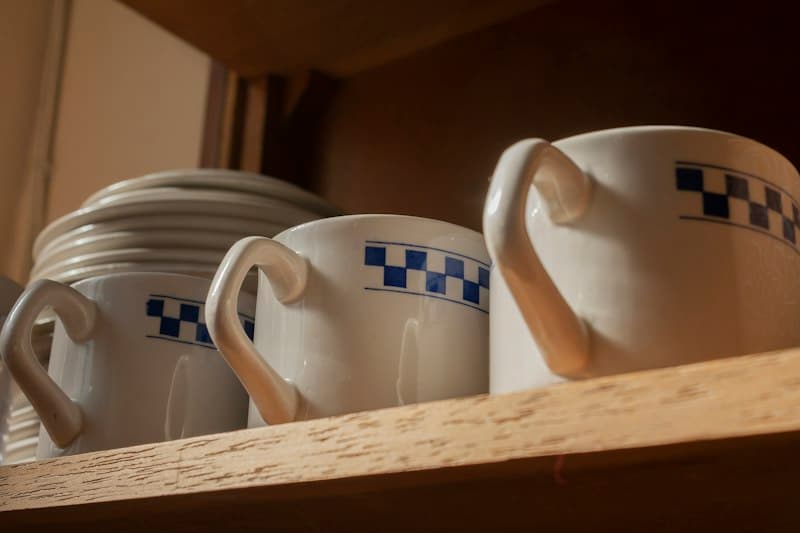
Wall shelves hold everything that does not fit on the counter, and they use no floor space. That makes them the most useful addition to a small coffee bar. They are also the piece most likely to fail, because a shelf is only as strong as the screws holding it to the wall. The product page will give you a weight rating. It assumes you hit studs.
This guide covers sizing, mounting height, real load limits and which type of shelf suits which job. Other furniture is on the furniture hub.
What to measure before you buy
- Width of the station below. The shelf should match it or sit slightly inside it.
- Height of your tallest item on the counter, with its lid open. That sets how high the first shelf goes.
- Stud positions. In most US homes studs are 16 in apart, center to center. Find them with a stud finder before choosing a shelf length, because bracket positions need to line up with them.
- Distance to the ceiling or upper cabinets. It decides if you have room for one shelf or two.
- What is going on the shelf, by weight. See the table further down.
| Dimension | Recommended | Why |
|---|---|---|
| Shelf depth | 6-8 in (15-20 cm) | A mug with handle is about 5 in across. Canisters are 4-6 in |
| First shelf above counter | 18-24 in (46-61 cm) | Machines and grinders are 12-17 in tall, plus lid and hand room |
| Spacing between shelves | 12-14 in (30-36 cm) | Fits a 12 in syrup bottle. Allow 15 in if bottles have pumps |
| Highest shelf for daily items | About 66 in (168 cm) from the floor | Above that, most people need a step stool |
| Shelf length | Same as the station below | A shelf narrower than half the counter looks lost |
With a 36 in counter, the first shelf lands 54-60 in off the floor and the second at 66-74 in. The second shelf is for things you reach for weekly, not daily.
How much weight coffee gear puts on a shelf
Add it up before you trust a rating.
| Item | Approximate weight |
|---|---|
| Ceramic mug | 0.75-1 lb each |
| Eight mugs | 6-8 lb |
| Canister with 12 oz of beans | about 2 lb |
| 750 ml glass syrup bottle, full | about 3 lb |
| Small potted plant | 2-4 lb |
| Electric kettle, empty | 2-3 lb |
A typical display shelf with six mugs, two canisters and a plant comes to about 12-15 lb. A row of six syrup bottles alone is 18 lb. Syrups are what overload shelves.
Shelf types compared
| Type | Realistic load, mounted in studs | Price | Difficulty | Best for |
|---|---|---|---|---|
| Budget floating shelf, hidden bracket | 15-25 lb | $10-$30 | Easy | Mugs, a canister, a plant |
| Heavy-duty floating shelf, steel rod bracket | 50 lb or more | $50-$100 | Moderate. Needs precise stud alignment | Syrup rows, heavier displays |
| Bracket shelf, board on L-brackets | 40-60 lb per pair of brackets | $15-$40 | Easy | Anything heavy. Strongest for the money |
| Shelf with mug hooks or rail underneath | 15-25 lb | $25-$50 | Easy | Mugs plus a canister in one piece |
| Pegboard with shelf accessories | A few lb per accessory | $15-$40 | Easy | Filters, scoops, tools, small items |
These are typical figures. Always go by the rating for the product you buy, and remember that the rating assumes correct mounting.
Floating shelves
No visible brackets, so the look is clean and suits a modern coffee bar. The hidden bracket is the weak point. It acts as a lever, and a deeper shelf multiplies the pull on the top screws. Keep floating shelves at 8 in deep or less, and keep heavy items near the wall.
Bracket shelves
Visible L-brackets under a board. Stronger than a floating shelf, easier to install and easier to level. The brackets become part of the look: black iron brackets under a reclaimed wood board are a farmhouse coffee bar standard. Choose a bracket whose arm is at least two thirds of the shelf depth.
Shelves with mug hooks
A shelf on top and hooks or a rail underneath, in one piece. This gets mugs off the shelf surface and frees it for canisters. Hang it so the bottom of the mugs, not the shelf, clears the machine. Hanging mugs take up about 5 in below the shelf. There is more on hooks, rails and trees in the mug rack guide.
Pegboards
Maximum flexibility, since hooks, cups and small shelves can be rearranged any time. Mount one behind or beside the station for filters, scoops, brushes and a tamper. The look is utilitarian. In a small kitchen it earns its place.
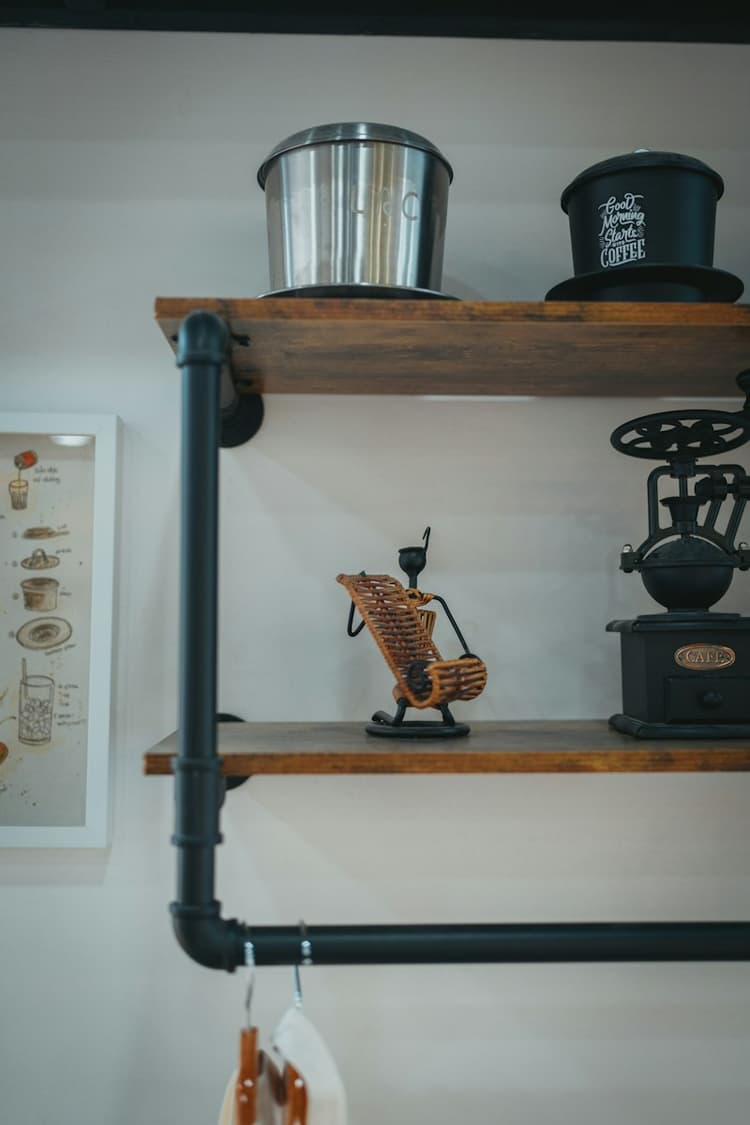
Mounting: studs and anchors
Screw into studs wherever you can. A 2.5-3 in wood screw into a stud holds far more than any drywall anchor.
If the bracket holes do not line up with studs:
- Toggle bolts are the right anchor for drywall. Use ones rated for 50 lb or more each, and still treat the shelf as light-duty.
- Plastic expansion plugs that come in the box are for pictures. They pull out of drywall under a shelf load, usually when someone grabs a mug from the front edge.
- Tile, brick or concrete needs a masonry bit and the matching anchors. On a tiled backsplash, drill through the grout line if the position allows.
Level the shelf, then load it gradually. If the front edge dips when you press on it, the anchors are already moving.
Renters who cannot drill have two options: a freestanding hutch that adds shelving on top of a cabinet, or a countertop riser shelf that stands on the counter itself.
Shelf materials
Steam and splashes reach the first shelf, so finish matters.
| Material | Near steam and splashes | Notes |
|---|---|---|
| Sealed solid wood | Good | Reseal if the finish wears. Strongest per inch of thickness |
| Laminate or foil over particle board | Good on faces, poor at cut edges | Hollow-core budget shelves cannot be cut to length |
| Raw or reclaimed wood | Poor until sealed | Seal with a clear matte finish before mounting |
| Metal | Very good | Can look cold. Mugs are noisy on it |
| Glass | Very good | Shows dust and water spots. Low load ratings |
Do not mount a shelf directly above a kettle spout or a machine's steam vent. Repeated steam lifts laminate and swells particle board. Shift the shelf up a few inches or slide the kettle sideways.
What to put on coffee bar shelves
Keep it functional: the mugs you use daily, a canister of beans, syrups if you use them, and one plant or a small sign. Leave about a third of each shelf empty. A packed shelf looks cluttered and makes it harder to grab a mug without knocking its neighbor.
Heaviest items go on the lowest shelf and closest to the brackets. Backup supplies belong in a cabinet, not on display. The organization guide has a zone system for what lives where, and the styling guide covers arrangement.
What to skip
- Shelves deeper than 10 in over a counter. You will hit your head leaning in, and the leverage on the bracket goes up.
- Floating shelves for syrup collections. Use a bracket shelf.
- Adhesive-mounted shelves for anything breakable.
- Three or more shelves unless the ceiling is high. The top one ends up out of reach and collects dust.
- Any shelf for the machine itself, unless it is a deep bracket shelf in studs rated well above the machine's weight.
Questions people ask
- How high should shelves be above a coffee bar?
- Mount the bottom of the first shelf 18-24 inches above the counter. That clears most coffee machines and grinders, which are 12-17 inches tall, and leaves room to open a top lid. Space a second shelf 12-14 inches above the first.
- How deep should coffee bar shelves be?
- 6-8 inches is enough for mugs, canisters and syrup bottles. A mug with its handle is about 5 inches across. Shelves deeper than 10 inches over a counter get in the way of your head when you lean in to use the machine.
- How much weight can a floating shelf hold?
- It depends on the bracket and the wall more than the shelf. A budget floating shelf screwed into studs usually carries 15-25 lb. Heavy-duty steel rod brackets in studs can carry 50 lb or more. In bare drywall with plastic plugs, assume very little.
- Can I put a coffee machine on a floating shelf?
- Not on a standard one. A machine weighs 5-30 lb, vibrates, and gets pushed and pulled daily. If the machine has to be wall mounted, use a bracket shelf at least 12 inches deep, screwed into studs, with a rating well above the machine's weight.
- How long should a shelf over a coffee bar be?
- Match the width of the furniture or counter section below, or go slightly narrower with equal margins each side. A short shelf centered over a wide cabinet looks like an afterthought.