How to Style a Coffee Bar: Layout, Decor and Lighting
Updated Sep 22, 2026 · 8 min read
Short answer
Keep 5-7 items visible, stick to two or three colors and two or three materials, and leave 30-40% of the surface empty. Add one plant, one piece of wall art and a warm white (2700K) light, and hide everything else in closed storage.
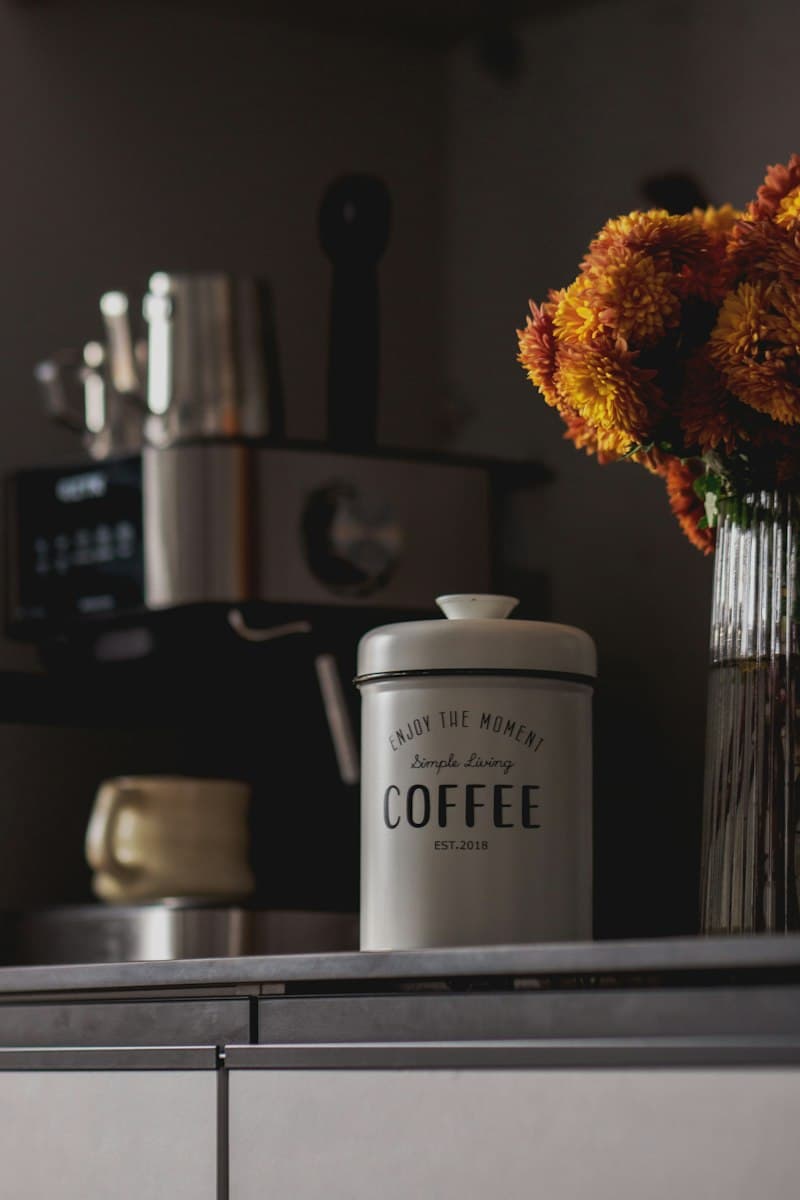
Most coffee bars that look good have six things on them, placed deliberately. Most that look messy have twelve, all perfectly nice, set down wherever there was room. How much you spent has little to do with it. Styling a coffee bar mostly means choosing what to leave off.
This guide covers the layout rules first, then the decor itself (signs, plants, lighting), then the mistakes that undo the work. Browse the coffee bar ideas gallery alongside it if you want to see the rules applied.
The numbers to style by
| Rule | Target |
|---|---|
| Visible items on the surface | 5-7 |
| Colors | 2-3 tones |
| Materials | 2, at most 3, each repeated at least once |
| Empty surface | 30-40% |
| Signs or wall art | 1 |
| Items on a tray | 3-5 |
| Light color | 2700-3000K warm white |
| Seasonal swaps | 3 items at most |
Start with a color palette of two or three tones
Too many colors is the most common mistake. Pick two or three tones and hold them across everything: containers, mugs, tray, sign, even the towel on the handle.
| Palette | Tones | Suits |
|---|---|---|
| Warm neutrals | Cream, tan, walnut, terracotta | Farmhouse and rustic setups |
| Cool monochrome | White, gray, matte black | Modern and minimalist kitchens |
| Earth tones | Olive, rust, warm brown | Natural wood, somewhere between the two |
If your kitchen already has a strong color, treat the coffee bar as an extension of it and don't introduce a contrasting accent.
A quick test: stand back and squint. If one item jumps out as louder than everything else, it's either your focal point or the thing to replace.
Pick two materials and repeat them
Wood and matte black. Marble and brass. White ceramic and bamboo. When everything on the bar shares the same two materials, with a third at most, it looks designed even if every piece came from a different store.
Repetition is what sells it. If you bring in a wooden tray, repeat the wood somewhere else, in a spoon holder or a shelf. A material that appears once looks accidental. One that appears twice looks like a decision.
Two failure modes to avoid. One is mixing too many finishes: a chrome machine, a wooden tray, a marble canister, a brass mug tree and a ceramic vase can each be nice and still fight each other. The other is using only one material. All stainless steel feels clinical, and all wood feels heavy. The contrast between two materials is what makes a setup interesting to look at.
Lay it out in thirds and balance the weight
Divide the surface into three zones, left, center and right. The machine anchors one. A taller element (canisters, a mug tree, a plant) goes in another. The third stays mostly open as working space. The result is balanced without being symmetrical, which tends to look stiff.
Visual weight matters too. A 20 lb espresso machine on one side needs something substantial on the other: a stack of mugs, a cutting board propped against the wall, a group of canisters. One small succulent won't balance it.
Layer it front, middle and back
Depth is what stops a coffee bar from looking like a row of appliances.
- Back: the tallest things, against the wall. The machine, a framed print, a shelf, a chalkboard.
- Middle: medium height. Canisters, grinder, mug tree, plant.
- Front: low things. A tray, a small bowl of sugar packets, a folded towel, a stack of coasters.
If everything sits in one row at one height, it looks cluttered no matter how few items there are.
Use a tray to group the small things
If the bar feels scattered, put a tray under the main cluster of small items. A rectangular serving tray, a wooden cutting board or a plain placemat makes a group of objects look like one composition. It also protects the top and lets you lift everything at once to wipe underneath.
The tray holds the small daily things: sugar bowl, creamer, a spoon, maybe a small plant. Keep the machine off it so it doesn't look crammed. Tray sizes and materials are covered in the accessories guide.
What to display and what to hide
- Display: things you use daily that also look good. Machine, grinder, a few favorite mugs, one canister of beans, a plant.
- Hide: backup supplies, filters, cleaning products, extra pods. Useful, not attractive.
This is where styling and organization overlap. A cabinet, a basket or a drawer takes the utilitarian stuff so the visible surface can stay clean.
Signs and wall art: one is enough
If something goes on the wall above the coffee bar, make it good enough to be the only thing there. Options that hold up:
- A framed vintage coffee advertisement print, usually $12-$25 framed
- A simple wooden sign with your last name or a single word
- A small piece of art that isn't about coffee at all, just something you like that suits the spot
- A chalkboard, but only if you update it. The same message for six months looks worse than a bare wall
Two related pieces are fine. Three or more and the bar starts to look like a gift shop. Pun signs have had their run, and a single plain piece ages better. There's more on choosing one in the signs section of the accessories guide.
A floating shelf or a wall-mounted mug rack also counts as your one thing above. It draws the eye up, uses wall that would otherwise be wasted, and frees counter space.
Plants do more than signs
A plant adds color and texture that no accessory matches, and it's the cheapest way to make the bar look less like an appliance shelf.
| Plant | Why it works | Where to put it |
|---|---|---|
| Pothos | Trails from a shelf, tolerates low light, hard to kill | Shelf above the bar |
| Small succulent or echeveria | Tiny footprint | On the tray, if the spot gets bright light |
| Mint or rosemary | You can use it in drinks | Near a window. Herbs need sun |
| Snake plant | Tall and narrow, doesn't spread | The corner beside or behind the machine |
Keep plants away from steam. If you use an espresso machine's steam wand regularly, the plant goes on the shelf above, not beside the machine.
Mood lighting for a coffee bar
Overhead kitchen light washes a coffee bar out and throws your shadow across it. One dedicated warm light makes the whole setup look intentional, and per dollar it's the best decor purchase available.
The spec to check is color temperature:
| Color temperature | Look | Use it |
|---|---|---|
| 2700K, warm white | Golden, like an incandescent bulb | Yes. The default for a cozy coffee corner |
| 3000K, soft white | Still warm, slightly crisper | Yes, if you want better visibility for measuring |
| 4000K and up, cool or daylight | Office breakroom | No |
If your kitchen's ceiling lights are cooler, which most are, the contrast helps. A warm pool of light around the coffee bar marks it off as its own zone.
Options, roughly in order of impact:
- Stick-on LED strip, $10-$25. Under the shelf or cabinet above, set about an inch back from the front edge so you see the glow and not the strip. An exposed strip looks cheap. Look for CRI 90 or higher, because low-CRI strips turn wood and coffee slightly gray-green. Most include a dimmer, and you should use it.
- Small table lamp, $15-$25. Off to one side, never behind the machine. It won't light the work surface, but with a warm bulb and shade it's the nicest thing to switch on at 6 AM before the ceiling lights.
- Puck lights, $15-$30 for three. Inside open shelves to pick out mugs, 8-12 in apart. Rechargeable ones suit renters and need charging every few weeks.
- Plug-in pendant, $25-$80. For a freestanding bar with nothing above it. Hang it centered, 28-34 in above the surface. Lower feels more intimate, higher spreads the light.
Plan the power before you stick anything up. A cord draped across the backsplash cancels out the effect. For the practical side, outlets and task lighting, see the setup guide.
Common styling mistakes
Overcrowding
This is the mistake that matters most. If no empty surface is showing, the bar looks crowded however nice the pieces are. Aim for 30-40% of the top visible. When in doubt, remove one thing. You will almost never want it back.
Too many signs
One is a focal point. Two can work if they relate. Past that, pick your favorite and let it stand alone.
Mismatched styles
A sleek modern espresso machine next to a barnwood sign next to a tropical plant is three different styles on one counter. Things don't have to match, but they should look like they belong in the same room. If you're unsure, follow the machine. It's the largest object and it sets the tone.
Ignoring the wall
A coffee bar that only uses the countertop wastes the wall above it. One shelf, one piece of art or a mounted mug rack gives the setup height and draws the eye up.
Seasonal updates in five minutes
Rotate accents, not the setup. Three swaps at most:
| Season | Mugs | Accent | On the tray |
|---|---|---|---|
| Fall | Warm-toned stoneware | Mini pumpkin or a bundle of cinnamon sticks | Pumpkin spice syrup |
| Winter | Plaid or red | String lights, a sprig of eucalyptus or a small garland | Peppermint syrup |
| Spring | Pastels | Fresh flowers in a small vase | Lighter accessories |
| Summer | Glass cups | Cold brew pitcher | Lavender syrup, iced coffee gear |
The base (machine, furniture, main canister) stays put year-round. For the syrups themselves, see what to stock.
The styling process, start to finish
- Clear everything off. Start with a blank surface.
- Place the machine. It's the anchor, so put it where it has power and working room.
- Add the grinder next to it, if you have one.
- Set the tray and group the small daily items on it.
- Add one tall element on the opposite side from the machine: a plant, canisters, a mug tree.
- Add one piece of wall art or a shelf above, with a warm light under it.
- Step back and check. If there's no empty surface showing, or one item jumps out, remove one thing.
- Live with it for a day before adding anything. You'll notice what's missing once you use it.
If you're leaning toward a specific look, the farmhouse and modern pages go deeper on each. More how-tos are in the guides hub.
Questions people ask
- How do I make my coffee bar look nice?
- Take everything off, put back the machine and grinder, group the small daily items on one tray, add one tall element on the opposite side and one piece of art or a shelf above. Keep to two or three colors and leave about a third of the surface empty.
- How many things should be on a coffee bar?
- Five to seven visible items is the comfortable range: machine, grinder, a canister, a mug or mug rack, one plant and perhaps one decorative piece. Twelve items reads as clutter no matter how nice each one is.
- What do you put on the wall above a coffee bar?
- One thing, good enough to be the only thing: a framed print, a simple wooden sign, a small piece of art, a floating shelf or a mounted mug rack. A chalkboard works only if you keep updating it.
- What plants work on a coffee bar?
- Pothos for trailing off a shelf in low light, a small succulent for a tray, a snake plant for a narrow corner, and herbs like mint or rosemary if the spot gets sun. Keep any plant out of the path of an espresso machine's steam wand.
- What color light is best for a coffee bar?
- Warm white, 2700K, or 3000K if you want a little more clarity for measuring and pouring. Avoid 4000K and above, which looks like office lighting.
- How do I decorate a coffee bar for the seasons?
- Swap three things at most: the mugs, one small accent and a seasonal syrup. The machine, furniture and main canister stay the same all year.