Home Barista Setup: Machine, Grinder and What Else You Need
Updated Sep 22, 2026 · 11 min read
Short answer
A solid starter espresso setup costs $310-$580: an entry-level semi-automatic machine ($150-$300), an espresso-capable burr grinder ($100-$170 for a hand grinder), and about $60-$110 of accessories. Spend at least as much on the grinder as on the machine, and plan for 24-30 in of counter width.
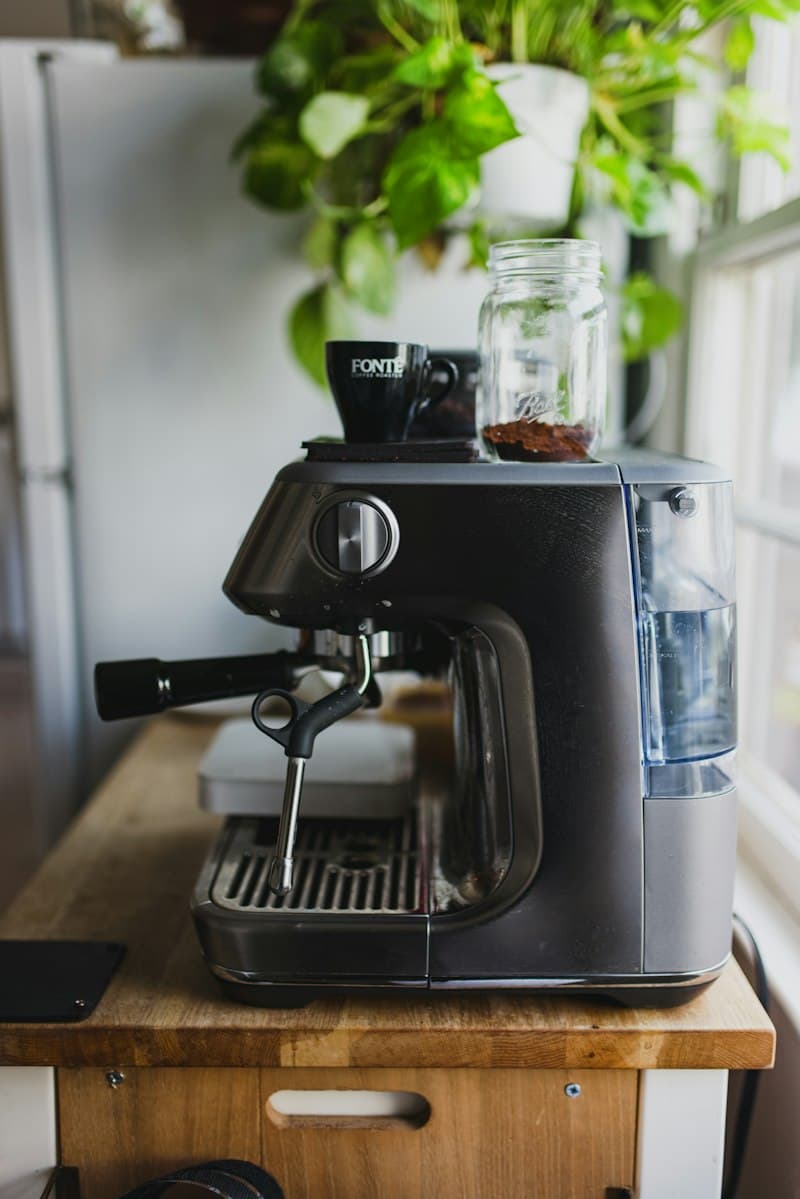
Two cafe lattes a day at $6 each comes to $4,380 a year. A solid home espresso setup costs $310-$580, which is 60 to 120 lattes' worth of equipment. At one drink a day it pays for itself in two to four months.
The hard part is working out what to buy, because espresso forums will tell you that anything under $2,000 is a toy. That's wrong. This guide covers the gear by category and price tier, what each tier gets you, and how to fit it all on a counter. Unfamiliar terms are defined in the glossary.
The grinder and the beans matter more than the machine
Most of what you taste in espresso comes from two things: how evenly the coffee is ground and how fresh the beans are. The machine supplies hot water at pressure. The grinder decides whether that water extracts the coffee evenly.
A $300 machine with a $200 grinder and fresh beans will beat a $1,500 machine fed pre-ground coffee, every time. So the budgeting rule is simple: spend at least as much on the grinder as on the machine, and more if you can. With a $200 espresso machine, the grinder should be $150-$200. If you brew with a $30 pour-over dripper, a $60 hand grinder is plenty.
Keep the beans fresh in an airtight, opaque canister and buy in amounts you'll finish within a few weeks.
Start with how you want to make coffee
Before comparing machines, decide which of these describes you. It matters more than any feature list.
- Casual. You want espresso drinks at home and you don't want a hobby. Good, not perfect, and no fuss. Look at a super-automatic or a good capsule machine.
- Enthusiast. You enjoy the process: dialing in, adjusting the grind, trying different beans. A semi-automatic with a decent grinder is where you'll be happiest.
- Serious. You've had great espresso and want to reproduce it, and you're willing to put time into technique. That means a prosumer semi-automatic or a manual lever machine.
Espresso machine types compared
| Type | What you do | Typical price | Good for | Trade-offs |
|---|---|---|---|---|
| Pod / capsule | Insert pod, press button | $100-$250 | Zero effort, tiny footprint | Higher cost per cup, limited coffee choice, pod waste. Close to espresso, not the same thing |
| Super-automatic | Fill beans and water, press button | $500-$2,000+ | One-touch lattes for a household | Expensive to buy and repair. Little control: if it tastes off, your main option is different beans |
| Semi-automatic | Grind, dose, tamp, start and stop the shot | $100-$1,500+ | The best espresso you can make at home | A learning curve, and you need a capable grinder |
| Manual / lever | All of the above, and you supply the pressure | Varies widely | Total control, no electronics to fail | Needs real skill and consistency. Better as a second machine than a first |
The rest of this guide assumes a semi-automatic, since that's what most home baristas buy.
What matters in a semi-automatic machine
Boiler type
| Heating system | How it works | What it means day to day |
|---|---|---|
| Thermoblock / thermocoil | Heats water on demand | Ready in about a minute. Fine for straight espresso, weaker for back-to-back milk drinks. Used in most machines under $500 |
| Single boiler | One boiler for brewing and steaming | You wait between pulling the shot and steaming milk while the temperature changes. Annoying but workable |
| Heat exchanger or dual boiler | Brews and steams at the same time | The real upgrade. Your workflow goes from sequential to parallel. Worth it if you make milk drinks every day |
Portafilter size
58 mm is the commercial standard. Entry-level machines often use 51 or 54 mm, which works fine, but 58 mm gives you far more choice in aftermarket baskets and tampers. It's a small detail that matters more as you improve.
Steam wand
If you drink lattes or cappuccinos, the steam side matters as much as the espresso side. A plain steam wand with decent pressure can make proper microfoam. Many entry machines fit a panarello (auto-frothing sleeve) instead, which makes foam but not microfoam. You get frothy milk from it, not the silky kind you can pour latte art with.
PID temperature control
A PID controller holds brew temperature steady and lets you adjust it. Darker roasts generally want slightly cooler water and lighter roasts hotter. Without one, temperature drifts and shots are less consistent. It's not essential on a first machine, but it becomes valuable once you're dialing in seriously.
Pressurized vs standard baskets
Entry machines ship with pressurized baskets, which fake crema and forgive an uneven grind. Standard (non-pressurized) baskets demand a better grinder and reward it with better espresso. If a machine can take both, you can learn on one and graduate to the other.
What doesn't matter much
- "15 bar" or "20 bar" pumps. Every box says it. Espresso extracts at around 9 bar at the group head. The pump rating is a maximum, like a car's top speed.
- A built-in grinder on a semi-automatic. It's convenient, but the grinder is the weaker half of the package. Most people eventually buy a separate one, and then the built-in one just takes up room.
- The brand name. At the same price, machines from the well-known brands are more alike than different inside. Choose on features and size.
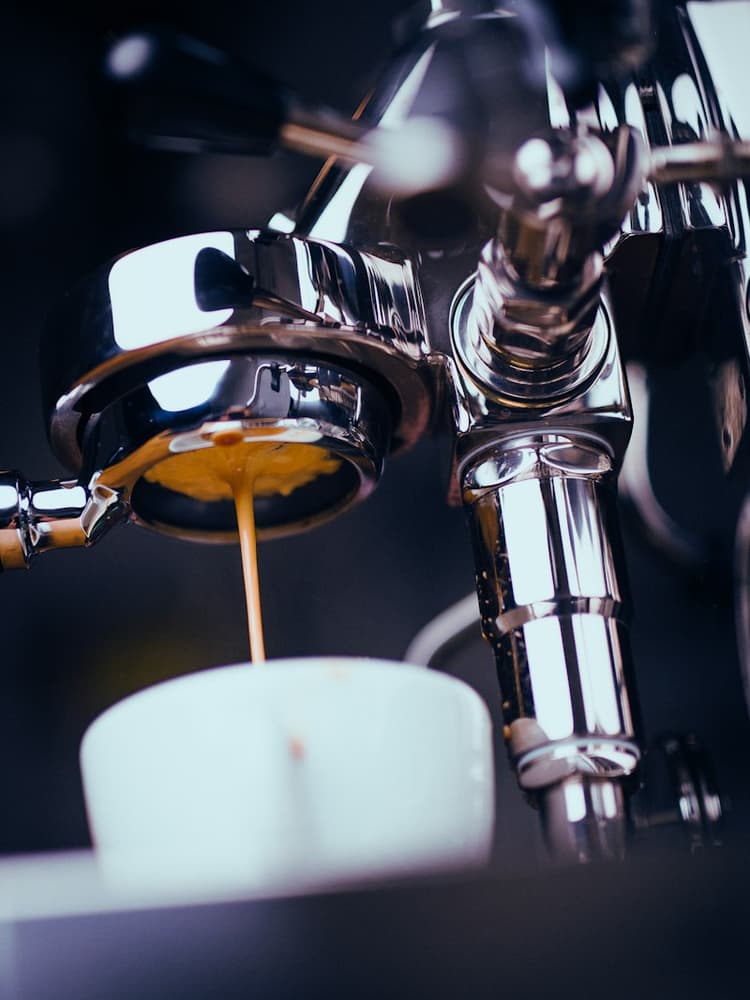
Espresso machine price tiers and what you get
| Tier | Price | What you get | Realistic result |
|---|---|---|---|
| Entry | $100-$300 | Thermoblock heating, pressurized baskets, usually a panarello wand, more plastic | Good espresso-style drinks and a big step up from drip. Temperature stability and steam power are the limits |
| Mid-range | $300-$700 | Standard baskets, steadier temperature, a proper steam wand, commercial-style portafilter | With a matching grinder, excellent espresso. Most home baristas settle here and stay for years |
| Prosumer | $700-$1,500+ | Heat exchanger or dual boiler, PID, 58 mm portafilter, metal construction built to last 10-20 years with maintenance | Better workflow and consistency, not a dramatic jump in flavor unless your technique keeps up |
A mid-range semi-automatic paired with a $150-$300 grinder will pull better shots than a $1,500 super-automatic. Don't jump straight to prosumer unless you know you're committed. A mid-range machine teaches the fundamentals, and plenty of people never need more.
Choosing a coffee grinder
Burr vs blade
Blade grinders chop beans at random. You get powder and chunks together: the powder over-extracts and tastes bitter, the chunks under-extract and taste sour, and you taste both in every cup. They cost $15-$30 and belong with the spices.
Burr grinders crush beans between two cutting surfaces set a fixed distance apart, so particles come out close to one size. Extraction is even and the results are repeatable. Every recommendation here assumes a burr grinder.
Manual vs electric
Hand grinders are quieter, smaller, and much cheaper for the burr quality you get. The cost is effort: 30-60 seconds of cranking per dose, longer at espresso fineness. For one or two drinks a day that's fine. For four people every morning, go electric.
Electric grinders are faster and easier for batches. Noise is the main downside, and it's worth thinking about if your station is a bedroom coffee station or shares a wall with one.
Conical vs flat burrs
For most home users this doesn't matter. Conical burrs are cheaper and quieter. Flat burrs produce slightly more uniform particles and a cleaner cup, but it takes very good beans and a practiced palate to tell. Below about $400, pick conical and move on.
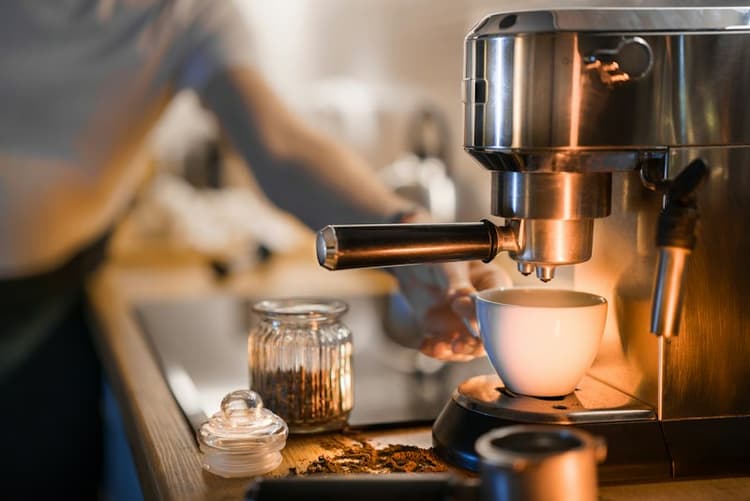
Grinder price tiers
| Tier | Price | Handles | Notes |
|---|---|---|---|
| Blade | $15-$30 | Nothing well | Skip |
| Manual burr | $30-$80 | Pour-over, drip, French press, AeroPress | Grinds more evenly than most electrics under $150. Usually not fine-adjustable enough for espresso |
| Manual burr, espresso-capable | $100-$250 | Everything, including espresso | The best value in espresso grinding. Competes with electrics at twice the price |
| Entry electric | $100-$200 | Drip, pour-over, French press | Stepped adjustment. Fine for filter coffee, too coarse in its steps for dialing in espresso |
| Electric, espresso-capable | $200-$400 | Espresso daily | Look for stepless or micro-step adjustment and low retention. The tier worth reaching if you pull shots every day |
| Prosumer single-dose | $400+ | Everything, switching beans freely | Gains are mostly workflow and retention. Grind quality improves, but incrementally |
For espresso, stepless or micro-step adjustment is the feature to insist on. Dialing in means very small changes, and a grinder with big steps will leave you stuck between too fast and too slow.
Match the grinder to how you brew
| Brew method | Grind | Grinder needed |
|---|---|---|
| French press, cold brew | Coarse | Almost any burr grinder. Don't overspend |
| Drip, pour-over | Medium | A $30-$80 hand grinder or an entry electric |
| AeroPress, moka pot | Medium-fine | Most burr grinders cover it |
| Espresso | Fine, with micro-adjustment | $100+ manual or $200+ electric |
Accessories worth buying
Buy these with the machine
| Accessory | Cost | Why |
|---|---|---|
| Scale with 0.1 g precision | $15-$25 | Espresso ratios are typically 1:2, for example 18 g in and 36 g out. Without a scale you're guessing. One with a built-in timer is handy |
| Tamper that fits your basket | $15-$30 | Stock tampers are often undersized. Match the basket diameter, usually 51, 54 or 58 mm. A calibrated tamper that clicks at a set pressure removes one variable |
| WDT tool | $10-$20 | Thin needles for stirring the grounds before tamping. Breaks up clumps so water flows evenly. You can make one from a cork and acupuncture needles |
| Knock box | $10-$20 | Somewhere to dump spent pucks that isn't a walk to the trash between shots |
| Milk pitcher, 12 oz | $10-$15 | For milk drinks. 12 oz suits single drinks. Stainless with a pointed spout gives the most control |
Nice to have later
- A dosing cup, to catch grounds from the grinder and transfer them cleanly
- A puck screen, for less cleanup and more even water distribution
- A bottomless portafilter, for diagnosing extraction problems
- A shot mirror, so you can watch the extraction without crouching
The general accessories guide covers mats, trays and the non-espresso side of the station.
Water quality
Espresso is mostly water, and the machine has to live with whatever you feed it.
| Water | Problem |
|---|---|
| Too hard (above about 150 ppm) | Scale builds up inside the machine and eventually damages it |
| Too soft (distilled, reverse osmosis) | Flat, lifeless espresso. Pure distilled water can also corrode internal parts over time |
| 50-120 ppm total dissolved solids | The target range |
A $10 TDS meter tells you where your tap water stands. A simple pitcher filter is usually enough to bring moderately hard water into range. If yours is very hard, mix filtered and distilled. Building water from distilled plus mineral packets gives precise control, but it's optional unless you're chasing the last few percent.
A repeatable daily workflow
Consistency is what separates good home espresso from frustrating guesswork.
- Turn the machine on and let it heat fully. That's about a minute for thermoblock machines and up to 25 minutes for large boiler machines.
- Weigh your dose. 18 g is standard for a double, but check your basket's rated range.
- Grind into the portafilter or a dosing cup.
- Stir with the WDT tool to break up clumps and level the bed.
- Tamp level and firm, about 30 lbs of pressure, straight down.
- Lock in the portafilter, put the cup on the scale, tare to zero.
- Start the shot. Aim for 36 g out in 25-35 seconds for a 1:2 ratio.
- Taste. Sour means under-extracted: grind finer. Bitter means over-extracted: grind coarser.
Change one variable at a time, and make grind size the first one. Once shots are consistently good, experiment with dose, ratio and temperature. Milk, syrups and the rest of the drink side are covered in what to stock.
How much space an espresso station needs
Espresso machines are bigger and heavier than people expect, so check the numbers before buying the machine or the furniture.
| What | Typical figure | Plan for |
|---|---|---|
| Compact machine footprint | About 10 x 12 in (25 x 30 cm) | The minimum. Many machines are wider |
| Machine depth | 14-18 in | A surface at least 16-18 in deep, with room for the cord behind |
| Machine height | 14-17 in | Standard upper cabinets sit 18 in above the counter, so a top-fill tank won't be reachable in place |
| Clearance above | 6-8 in | To lift the tank lid, load a bean hopper and use the cup warmer. Otherwise plan to slide the machine forward |
| Machine + grinder width | 20-24 in minimum | 30 in or more for machine, grinder, knock box and tamping space |
| Machine weight | 15-25 lbs mid-range, 40-60 lbs prosumer | A cabinet or table rated for it. Many light carts are not |
| Power draw | 1,000-1,600 W | A 15-amp circuit gives 1,800 W total, so don't run a kettle on the same circuit at the same time |
Layout tips:
- Grinder directly beside the machine, on your dominant-hand side. The portafilter then moves from grinder to tamper to group head in one short path.
- A silicone mat under everything from day one. Espresso is messy: stray grounds, splashes, purge water.
- Knock box within reach of the group head, not across the counter.
- Steam wand side clear. You need elbow room to hold a pitcher at an angle.
If counter space is tight, the small coffee bar ideas page covers layouts for narrow counters. For the general process of choosing a spot and furniture, see how to set up a coffee bar at home, and for keeping the station tidy once it's running, the organization guide.
Starter budget breakdown
| Item | Cost |
|---|---|
| Entry-level semi-automatic machine | $150-$300 |
| Espresso-capable hand grinder | $100-$170 |
| Scale | $15-$25 |
| Tamper | $15-$30 |
| WDT tool | $10-$20 |
| Knock box | $10-$20 |
| Milk pitcher | $10-$15 |
| Total | $310-$580 |
If you'd rather have an electric grinder, add $100-$200 to the total. If the budget has to give somewhere, cut the machine tier before the grinder tier.
More how-tos are in the guides hub.
Questions people ask
- How much should I spend on my first espresso machine?
- For most beginners, $200-$400 on the machine plus at least $100-$200 on an espresso-capable burr grinder. That buys a semi-automatic that makes properly good espresso. Going much under $150 on the machine usually means compromises that make learning harder, not easier.
- What's the difference between semi-automatic and super-automatic espresso machines?
- With a semi-automatic you grind, tamp and time the shot yourself, and the machine handles pressure and temperature. A super-automatic grinds, brews and froths milk at the push of a button. Semi-automatics make better espresso if you're willing to learn. Super-automatics are for good coffee with no effort.
- Do you need a separate coffee grinder for espresso?
- Almost always, yes. Built-in grinders on most machines under $800 are the weak part of the package, and grind consistency is the biggest factor in espresso quality. Budget $100-$250 for an espresso-capable hand grinder or $200-$400 for an electric one with stepless adjustment.
- How much counter space does an espresso machine need?
- A compact machine has a footprint of about 10 x 12 in, and most are 14-17 in tall with a top-fill tank that needs hand room above. With a grinder beside it, plan for 20-24 in of width at minimum and 30 in or more to work comfortably, on a surface 16-18 in deep.
- Are pod espresso machines worth it?
- For convenience, yes. The better capsule systems make a decent espresso-style drink with no learning curve. For real espresso quality, no, because pods can't match freshly ground beans in a semi-automatic. The cost per cup is also higher.
- Is a blade grinder good enough for espresso?
- No. Blade grinders chop beans into a mix of dust and chunks, and espresso needs a fine, uniform grind with very small adjustments. Even an inexpensive hand burr grinder produces a more even grind than any blade grinder, though for espresso you need one built for fine adjustment.