Coffee Bar Cabinets: How to Choose One That Fits
Updated Sep 22, 2026 · 10 min read
Short answer
A coffee bar cabinet should be 34-36 in (86-91 cm) tall, at least 30 in (76 cm) wide and 16 in (41 cm) deep for a machine plus grinder. Measure your machine first, then check the top's weight rating and that the back panel lets a power cord through.
Retailers sort coffee bar cabinets by color and price. Neither tells you if your machine fits under the hutch shelf, if the top will sag under an espresso machine, or where the power cord goes. This guide covers the part the product pages skip: what to measure, what size you need for your setup, which materials survive daily spills, and which features are not worth paying for.
If you are still deciding between a cabinet, a cart and a table, start at the furniture hub. Short version: a cabinet is the right pick when you want closed storage and a piece that stays put.
What to measure before you buy
Measure the machine first, then the wall, then the cabinet listing. In that order.
- Machine footprint. Width and depth of every appliance that will live on top, plus 2-3 in behind each one for the plug and cord.
- Machine height in use. Not the height on the spec sheet. The height with the water tank lid open, the hopper lid off, or a hand lifting the carafe out.
- Wall width. The clear run between door frames, corners and other furniture. Note where the outlet is.
- How far the cabinet can stick out. Keep 36 in (91 cm) of walkway in front of it. In a hallway or behind a sofa that usually caps cabinet depth at 16-18 in.
- Door and drawer swing. A 16 in wide cabinet door needs 16 in of clear floor in front of it to open fully.
Typical appliance sizes, so you can sanity check a listing before you own the machine:
| Item | Width | Depth | Height | Weight |
|---|---|---|---|---|
| Pod machine | 5-9 in | 12-15 in | 10-13 in | 5-10 lb |
| Drip coffee maker | 7-10 in | 9-14 in | 12-15 in | 5-10 lb |
| Home espresso machine | 9-13 in | 12-16 in | 14-17 in | 15-30 lb |
| Burr grinder | 5-8 in | 7-10 in | 13-17 in | 5-15 lb |
| Electric kettle | 6-9 in | 9-11 in | 8-10 in | 2-3 lb empty |
Prosumer espresso machines with big boilers can run 40-60 lb. If you own one of those, the top's load rating is the first thing to check, not the last.
What size cabinet you need, by setup
Pick the row that matches what you will put on top. These are top surface sizes, not overall cabinet sizes, so check that the listing's width is the top and not the widest point of the legs or trim.
| Setup | Min. top width | Min. top depth | Top should carry |
|---|---|---|---|
| One drip or pod machine, mugs | 24 in (61 cm) | 15 in (38 cm) | 20 lb |
| Machine plus grinder | 30 in (76 cm) | 16 in (41 cm) | 40 lb |
| Espresso machine, grinder, knock box, tamping space | 36-42 in (91-107 cm) | 18 in (46 cm) | 60 lb |
| Two machines, or coffee plus tea and a kettle | 48-60 in (122-152 cm) | 18 in (46 cm) | 75 lb |
Height stays the same across all of them: 34-36 in (86-91 cm), standard counter height. Lower sideboards at 30-32 in are fine for a drip machine you just press a button on. They get tiring if you tamp espresso every morning. Bar height (40-42 in) puts the top of a 15 in machine at eye level, which makes filling a top-loading water tank awkward.
If a mini fridge is part of the plan, it needs its own bay or a spot beside the cabinet, plus ventilation space. That is covered in the mini fridge guide.
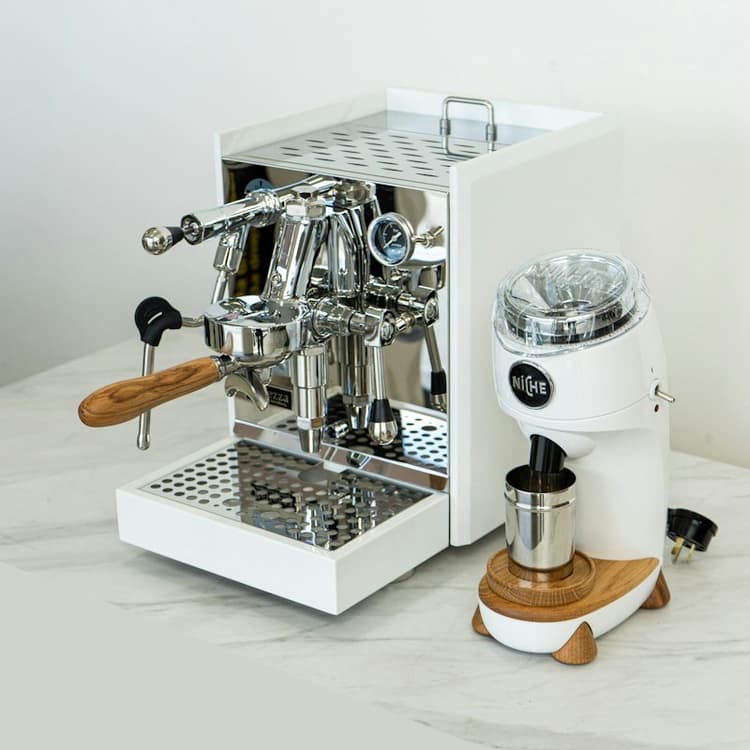
Clearance above the machine
If anything sits above the cabinet top, such as a hutch shelf, wall cabinets or floating shelves, you need the machine's height plus room to use it.
| What is on top | Clearance needed above the counter |
|---|---|
| Front-fill pod or drip machine | 16 in (41 cm) |
| Top-fill drip machine or espresso machine | 18-20 in (46-51 cm) |
| Grinder with hopper you refill in place | Grinder height plus 4-6 in |
Kitchen wall cabinets hang 18 in above the counter, which is why so many people slide their machine forward to fill it. With a freestanding cabinet you get to choose, so choose 18 in or more. The hutch guide goes further into this, because clearance is where hutch purchases go wrong.
The four types of coffee bar cabinet
Bar cabinets
The default. Usually 36-40 in tall and 30-40 in wide, with a flat top and a mix of doors, a drawer and an open shelf below. Many add a wine rack or stemware rail. If you do not drink wine, that rack is dead space. A plain shelf holds more.
Buffets and sideboards
Wider (48-60 in) and lower (30-34 in). Good if you run two machines or want mugs displayed beside the machine. They need a dedicated wall and they eat floor space, so they suit dining rooms and large kitchens better than apartments. More on these in the coffee bar tables guide.
Hutch-style cabinets
A base cabinet with a shelf unit on top. You get vertical storage without drilling into a wall, at the cost of fixed clearance above the machine. Measure for 16 in minimum between the counter and the underside of the upper section, and 18-20 in if you can find it.
Repurposed furniture
The best value in coffee bar cabinets is often not sold as one. A secondhand dresser, a credenza or a baker's rack can do the job for well under $100. Two tests: the top is level and carries 30 lb or more without flexing, and there is a way to route a power cord. Paint and new hardware cost about $30. The DIY coffee station guide walks through the conversion, and the IKEA coffee bar guide covers the flat-pack route.
Materials compared
The top takes water, coffee and milk every day. Judge the top surface first and the rest of the cabinet second.
| Material | Handles spills | Carries weight | Typical price tier | Watch for |
|---|---|---|---|---|
| Particle board, laminate or melamine finish | Good on the face, poor at exposed edges | Fair. Sags over long unsupported spans | Under $200 | Swelling where water gets into an unsealed edge or a drilled hole |
| MDF, painted or laminated | Good if the finish is intact | Fair to good | $150-$400 | Chipped paint on the top lets moisture in |
| Plywood with veneer | Good | Good | $300 and up | Thin veneer can lift if left wet |
| Solid wood | Needs a sealed finish | Very good | $400 and up | Water rings on oiled or waxed tops |
| Metal frame with wood or stone top | Very good | Very good | $250 and up | Open frames mean no closed storage |
For most people, laminate or melamine over MDF is the practical choice. It wipes clean and costs far less than hardwood. Avoid any piece with an unfinished particle board top or raw edges at the back, because that is where a leaking water tank ends up.
Whatever the material, a tray or mat under the machine keeps drips off the surface.
Shelf load and interior storage
Closed storage is the reason to buy a cabinet over a table, so check the inside as carefully as the top.
- Adjustable shelves. Coffee bags, mugs and syrup bottles are all different heights. A 750 ml syrup bottle is about 12 in tall, and 14-15 in with a pump in it. Fixed shelves at 10 in spacing will not take them.
- Per-shelf rating. Flat-pack shelves are often rated somewhere around 25-45 lb. A dozen mugs weigh 10-12 lb, and six full glass syrup bottles about 15-18 lb, so one shelf of each is fine. Stacking all your syrups and a case of pods on one shelf is not.
- At least one drawer. Spoons, filters, a scale and cleaning tablets need somewhere to go that is not the countertop.
- Doors that open the right way. If the cabinet goes in a corner, the door should hinge on the wall side so it opens toward you.
Power access
The cabinet sits against a wall and the machine needs an outlet. If the back panel is solid and the top has no cutout, you will be either drilling a hole or leaving the cabinet pulled a few inches off the wall.
Look for an open back behind the top shelf, a cable hole in the back panel, or a gap between the top and the back rail. Drilling a 2 in hole in a thin hardboard back is easy. Drilling through a finished top is a bigger decision, and you should seal the cut edge afterward.
An espresso machine draws 1,200-1,600 W while heating. A standard 15-amp kitchen circuit supplies 1,800 W, so a machine and a kettle running at once on the same circuit can trip the breaker. Plug the machine directly into the wall, not into a light-duty power strip inside the cabinet.
Corner cabinets
A corner uses floor space that is otherwise wasted, but corners have geometry problems flat walls do not. There are three ways to do it.
A standard cabinet pushed into the corner
The simplest option. One side goes against the side wall and the front faces out. Leave 4-6 in between the cabinet and the side wall if a door or drawer needs to clear the baseboard and open fully. Put the side with doors and drawers facing the room.
A diagonal corner cabinet
Built to sit at 45 degrees across the corner. You get a front face pointing into the room and a deep triangular space behind it. The back third is hard to reach, so items get lost there unless the cabinet has a rotating shelf. Also note that the front face is much narrower than the wall space the cabinet takes up. Read the listing for both numbers: wall run per side, and usable top width.
An L-shaped setup
Two pieces, one on each wall: a cabinet on the longer wall and a small table or cart on the other. This gives more usable surface than any single corner piece and everything stays reachable.
How to measure a corner
| Measure | Why |
|---|---|
| Wall run on both sides, corner to the first obstacle | Sets the maximum cabinet width on each wall |
| Depth available before the walkway drops under 36 in | Usually leaves 18-24 in for furniture |
| Outlet position | Corners often have an outlet on one wall only |
| Baseboard and trim thickness | Stops the cabinet sitting flush. Often 0.5-0.75 in |
Corner limitations
A corner setup has less usable surface than a wall setup with the same footprint. Corners are dark, so a plug-in under-shelf light is close to mandatory. And if the layout forces the machine to face into the corner, you brew with your back to the room. If that bothers you, floating corner shelves above an existing counter, or a 20-24 in round table, are lighter alternatives.
Price tiers and what you get
| Budget | What you get | Good for |
|---|---|---|
| Under $200 | Particle board or MDF, basic hinges, thin back panel | Drip and pod setups, renters, first coffee bar |
| $200-$400 | Thicker panels, soft-close hinges, smoother drawer slides, more finishes, glass doors | Espresso setups, living room or dining room placement |
| $400 and up | Solid wood or plywood, real joinery, stone or hardwood tops | A piece that sits with your other furniture for ten years |
The middle tier is where most people should land. Under $200 works if you check the top's load rating and treat the edges carefully. Above $400 you are buying furniture that happens to hold coffee, which is reasonable if it sits in a room where you care how it looks.
What to skip
- Built-in wine racks and stemware rails if you will not use them. They take the space of a full shelf.
- Bar-height cabinets for espresso. Tamping and filling at 42 in is uncomfortable.
- Glass tops. They show every drip and ring, and rattle under a vibrating pump.
- Tops under 15 in deep. The machine overhangs or sits right at the edge.
- Solid backs with no cutout unless you are happy to drill.
- Towel bars on the side if the cabinet goes in a corner or between other furniture. They add 2-3 in of width you cannot use.
Once the cabinet is chosen, the setup guide covers placement, outlets and what goes where.
Questions people ask
- What is the best height for a coffee bar cabinet?
- 34 to 36 inches, which is standard kitchen counter height. At that height you can fill a machine, tamp espresso and pour without hunching. Avoid bar-height pieces (40-42 inches) unless the machine is short and you never need to see into the top of it.
- How wide should a coffee bar cabinet be?
- At least 30 inches for a machine and grinder side by side with a little working room. A single drip or pod machine fits on 24 inches. Go 36 inches or wider if you want mugs, a canister or a knock box on the top as well.
- How deep should a coffee bar cabinet be?
- 16 inches is the practical minimum and 18-20 inches is more comfortable. Most espresso machines are 12-16 inches deep and the plug needs another 2-3 inches behind them.
- Is MDF or solid wood better for a coffee bar cabinet?
- MDF or particle board with a laminate or melamine surface is the practical choice: it wipes clean and shrugs off small spills as long as the edges are sealed. Solid wood looks better and lasts longer, but the top needs a sealed finish to handle water and coffee.
- Can you use any cabinet as a coffee bar?
- Yes, if the top is flat, close to counter height and strong enough. Dressers, credenzas, sideboards and flat-pack storage units all work. Check that the top can carry 30-40 lb without flexing and that there is an open back or a cutout for the power cord.
- Is an IKEA cabinet good enough for a coffee bar?
- For a drip machine or a light setup, yes. For a heavy espresso machine, check the stated max load for the top panel and add a solid wood or butcher block slab on top to spread the weight if it is borderline.